Corma raises $125 million at a $1 billion valuation; the security claims still need testing
The funding announcement describes plans to expand compute capacity, but a financing valuation does not measure a defensive AI system’s reliability.
Corma says it has raised a $125 million Series A at a $1 billion valuation, three months after emerging from stealth. The financing is a major expression of investor confidence. It does not independently establish how well the company’s AI security workforce performs, how often people must intervene or what customers ultimately pay for successful work. Corma’s Nov. 16 announcement.
NEA led the round, with returning investors Sequoia Capital, Khosla Ventures and Coatue. Corma puts total funding at $185 million after an earlier $60 million financing. Its announcement says new resources will expand model training and compute capacity, alongside selective hiring. These are company-reported financing details and intentions. Corma announcement.
Funding and valuation answer different questions#
The $125 million figure describes the new financing. The $1 billion figure describes the valuation attached to the round. Neither is a report of revenue, profit or cash remaining after expenses.
Dividing the financing by the valuation yields 12.5%, but that arithmetic alone cannot establish the investors’ ownership. Readers would need the valuation’s pre-money or post-money basis and the transaction terms. Treating the result as a disclosed ownership stake would turn an unstated assumption into a supposed fact.
The timing needs similar care. Emerging from stealth means becoming public about the business; it is not necessarily the company’s founding date or the beginning of technical work. The three-month interval is a measure of time between public announcements, rather than proof that a complete enterprise was built in that period.
Globes’ funding report and Ctech’s account describe a small team but give different approximate staff counts. That disagreement is another reason to avoid presenting a precise valuation-per-employee ratio as an operating result. Such a ratio would also say little about how much work the product completes.
The buyer’s test is successful, controlled work#
Corma describes models that carry out defensive tasks through customers’ existing security tools. It also says demand has constrained available compute. Those are the supplier’s descriptions; the announcement is not a comparative evaluation by an independent laboratory. Corma announcement.
For a buyer, an attractive demonstration would be the start of an assessment. A useful test would use representative tasks, record failures as well as successes, and separate actions taken by the software from corrections made by people. Without those distinctions, an impressive final result can conceal a costly review process.
| Assessment question | Evidence a buyer could request |
|---|---|
| Does it complete useful work? | Defined tasks and documented outcomes |
| Does it act within its authority? | Access limits and action logs |
| What does it cost in practice? | Compute, integration and human-review costs |
These are editorial assessment criteria, not disclosed Corma results or claims that its product has failed them.
The cost question is especially important when a system can take actions. A fast answer that requires a lengthy check may create less capacity than a slower answer that is easier to trust. Conversely, a product that handles a narrow but frequent task reliably could be valuable without replacing an entire security team. A funding headline cannot resolve that tradeoff.
The voluntary NIST AI Risk Management Framework offers a broader reference for assessing trustworthiness throughout an AI system’s use. It is not a certification of Corma, and citing it does not establish that NIST has evaluated this company. Its relevance is the need to make evaluation part of deployment rather than infer reliability from investment.
The next evidence should concern delivery#
The financing gives Corma resources to pursue its plan. A stronger operating assessment would require evidence about customer retention, completed work, safeguards and the economics of serving demand. Those measures should specify the period, workload and role of human reviewers so that comparisons are meaningful.
This article does not independently verify customer performance or a revenue figure. Its narrower conclusion is that investors have financed a substantial expansion plan, while the product’s practical value remains a separate question for evidence.
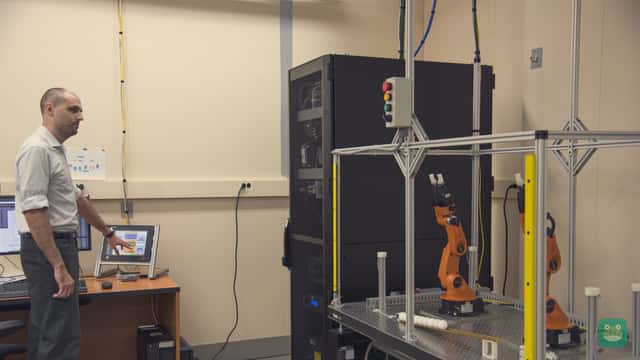
Illustrative photo: F. Webber/NIST, smart manufacturing systems cybersecurity testbed, 2017. Public U.S. government photograph under NIST’s copyright policy; cropped and badged. It depicts cybersecurity research, not a Corma facility, product or employee, and implies no endorsement.
Cite this article
567 Business AI Desk. “Corma raises $125 million at a $1 billion valuation; the security claims still need testing.” 567 Business. Published 2026-11-16. https://www.567business.com/news/corma-125-million-series-a-1-billion-valuation-three-months-after-launch
Wikipedia citation
{{cite news |title=Corma raises $125 million at a $1 billion valuation; the security claims still need testing |url=https://www.567business.com/news/corma-125-million-series-a-1-billion-valuation-three-months-after-launch |work=567 Business |author=567 Business AI Desk |date=2026-11-16 |language=en}}CSL-JSON for reference managers
{
  "id": "https://www.567business.com/news/corma-125-million-series-a-1-billion-valuation-three-months-after-launch",
  "type": "article-newspaper",
  "title": "Corma raises $125 million at a $1 billion valuation; the security claims still need testing",
  "URL": "https://www.567business.com/news/corma-125-million-series-a-1-billion-valuation-three-months-after-launch",
  "container-title": "567 Business",
  "language": "en",
  "author": [
    {
      "literal": "567 Business AI Desk"
    }
  ],
  "issued": {
    "date-parts": [
      [
        2026,
        11,
        16
      ]
    ]
  }
}Citations identify this article and its publication date. Assess the reporting and its linked sources before using it as evidence.
Read this article as Markdown or JSON. Cite the original page and retain its sources, dates and qualifications.
Embed this article summary
Paste this HTML into your page. The summary stays linked to the full story and updates with it. No account required.
<iframe src="https://www.567business.com/embed/news/corma-125-million-series-a-1-billion-valuation-three-months-after-launch?theme=auto" title="Corma raises $125 million at a $1 billion valuation; the security claims still need testing by 567 Business" width="100%" height="440" style="border:0;max-width:100%" loading="lazy"></iframe>
<p style="font-size:14px">Corma raises $125 million at a $1 billion valuation; the security claims still need testing by <a href="https://www.567business.com/news/corma-125-million-series-a-1-billion-valuation-three-months-after-launch" rel="nofollow">567 Business</a></p>
<script async src="https://www.567business.com/embed.js"></script>